Jobs in Georgia
From Metro Atlanta to the Savannah Port Authority
By W. Calvin Anderson, MS. ED.
APRIL 14, 2026
As the Class of 2026 enters the final stretch of their secondary education this April,
the conversation must shift from academic compliance to economic positioning. We
are no longer merely preparing students for "graduation"; we are preparing them to
claim market share in a Georgia economy that is currently outperforming national
trends. From the logistical heartbeat of Hartsfield-Jackson to the industrial
expansion of the I-16 corridor ending at the Savannah Port Authority, the
opportunities are massive, but they require a strategic "behavioral mapping" of
skills to sectors.
The Georgia Economic Corridor: A 250-Mile Engine
The geography of opportunity for the Class of 2026 is defined by the 250-mile stretch
connecting Metro Atlanta’s technology and film hubs to Savannah’s global logistics
gateway. This corridor is underpinned by multi-billion dollar investments in Electric
Vehicles (EV), sustainable energy, and aerospace. For a student to successfully
navigate this, their "Postsecondary Prospectus" must align with the state’s 17 Career
Clusters.
Strategic Scholar Note: A student with a 2.5 GPA in Aviation Maintenance or HVAC Technology
currently possesses a higher immediate "market value" in the Savannah-Port region than a
generalist 4.0 student without a technical concentration. Strategy beats raw data every time.
Pathway Alignment: Behavioral Market Positioning
To claim market share, students must view their CTAE (Career Technical and
Agricultural Education) pathways as professional assets:
Infrastructure & Energy: Pathways in Construction, Energy Systems, and
HVAC are the backbone of Georgia's "Signature Cities." These students are the
architects of the new EV infrastructure.
Aviation & Logistics: With Aircraft Support and Flight Operations, students are
positioning themselves for careers with Gulfstream and Delta, where entry-
level technical roles now rival starting salaries for many four-year degree
holders.
Consumer Science & Design: Interior Design and Nutrition are no longer
"electives." In the Atlanta film industry and the statewide hospitality boom,
these are essential components of the Experience Economy.
August 2026: The Funding Fast-Track
The bridge between April and August is built on financial strategy. The HOPE
Career Grant is the primary tool for those entering high-demand technical fields.
Unlike the traditional HOPE Scholarship, the Grant targets specific "gaps" in the
Georgia workforce—Welding, Aviation, and Health Sciences—often covering 100%
of tuition at Technical College System of Georgia (TCSG) institutions.
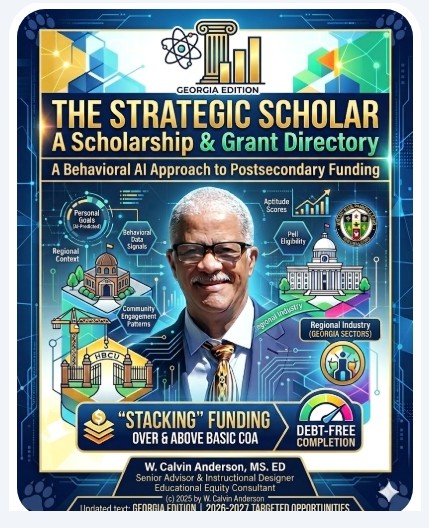
The Behavioral Shift: We urge the Class of 2026 to utilize GA Futures not as a grade-checker,
but as a Funding Portfolio. By May 1st, every student should have mapped their specific
Pathway Completion to a corresponding high-demand funding code.
Conclusion: From Student to Stakeholder
The "Third Reconstruction" of our educational framework requires that we view the
student as a stakeholder in the state's growth. Whether you are in New Rochelle or
Stonecrest, the methodology remains the same: Identify the strength, map the
course, and claim the share. The Class of 2026 is not just finishing school; they are
starting their tenure as the builders of Georgia's future.
© 2026 W. Calvin Anderson, MS. ED. | The Strategic Scholar: Georgia Edition
"Your high school schedule is your first business plan."